
Last Updated: 10/22/26
Since 1992, the Secret Cinema has been the Philadelphia area’s premiere floating repertory cinema series, bringing hundreds of unique programs to nightclubs, bars, coffee houses, museums, open fields, colleges, art galleries, bookstores, and sometimes even theaters and film festivals. Drawing on its own large private film archive (as well as other collections), the Secret Cinema attempts to explore the uncharted territory and the genres that fall between the cracks, with programs devoted to educational and industrial films, cult and exploitation features, cartoons, rare television, local history, home movies, erotic films, politically incorrect material, and the odd Hollywood classic. As long as it exists on real celluloid, that is—Secret Cinema screenings never use video/digital projection. While mainly based in Philadelphia, the Secret Cinema has also brought programming to other cities and countries.
Friday, October 23, 2026
8:00 pm
Admission: $15.00
Allens Lane Art Center
8:00 pm
Admission: $15.00
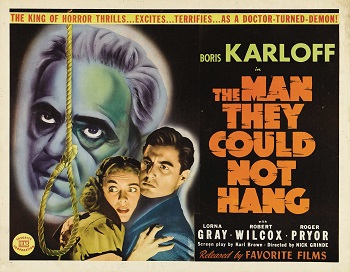
On Friday, October 23, the Secret Cinema will present a special pre-Halloween screening at a new venue for us -- the Allens Lane Art Center, in the heart of Philadelphia's Mt. Airy neighborhood. Featured will be the vintage Boris Karloff horror film The Man They Could Not Hang. A concise and creepy chiller with no wasted frames (in the tradition of 1930s-40s B-movies; it only runs 65 minutes!), we'll fill out the program with some surprise, spooky short films from the Secret Cinema archive.
There will be one complete show at 8:00 pm. Admission is $15.00.
A description of the feature follows…
The Man They Could Not Hang (1939, Dir: Nick Grindé)
Boris Karloff stars in this under-appreciated chiller from the actor's B-movie middle period. He plays Dr. Henryk Savaard, a scientist who has invented an artificial heart for reviving patients whose own heart has stopped. His assistant agrees to be used as a test subject, but the police burst into his lab before the operation is completed, and when the assistant dies, arrests the doctor for murder. Found guilty and sentenced to death by electrocution, he manages to secretly survive his own execution with his invention. Savaard, previously laboring to help all humanity, turns insane and vengeful, devising a plot to gather the district attorney, judge and jurists into a trap where they will all die, one by one!
Boris Karloff (nee William Henry Pratt) signed to a five-picture deal with Columbia Pictures -- and all of them featured "mad doctor" roles for the star. The first three, all directed by Grindé, had near-identical plots about returning from the dead! The Man They Could Not Hang, their first collaboration, was the best of the group, with a somewhat larger budget that shows in the detailed laboratory scenes and relaxed pace that allows Karloff to shine in an impassioned courtroom monologue. The film then provides perhaps guilty pleasure, as the darker, post-execution Dr. Savaard reveals the twisted, clever variety of ways he has planned to dispatch his enemies. Surprisingly, this part of the story was echoed in the plot of Agatha Christie's most popular novel, And Then There Were None...which was published almost three months after the premiere of The Man They Could Not Hang (and years before Christie's book was adapted for the screen).
2008 interview with Secret Cinema's Jay Schwartz from an academic journal
Channel 29 news piece on Secret Cinema from 1999!
Secret Cinema 1999 Annual Report
Secret Cinema 1998 Annual Report
Secret Cinema 1997 Annual Report
Information about the 1998 Secret Cinema "Class Trip" to the Syracuse Cinefest